Your Phone Thinks it Knows What Your Home Is Worth. It Doesn’t.
What every buyer and seller needs to know about AI, online home values, and when to trust a human instead.
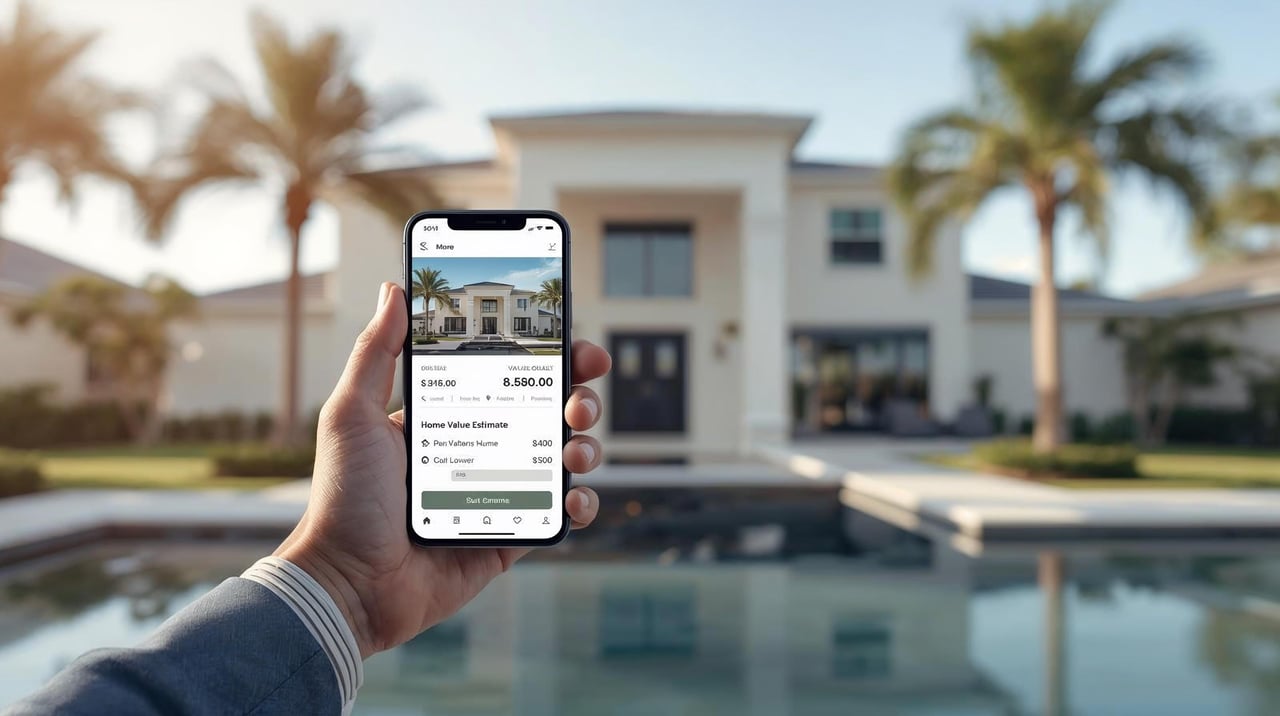
You’ve probably done it. You type your address into Zillow, Redfin, or an AI chatbot, and within seconds you have a number. It looks official. It feels accurate and it’s packaged by brands that give enough confidence that it’s hard not to believe it.
But here’s what those things won’t tell you; AI is designed to give you an answer that feels satisfying, not one that is necessarily accurate. In a real estate transaction worth hundreds of thousands of dollars, that distinction matters enormously.
On a $700,000 home, the error rate built into most AI valuation tools can swing $42,000 - $70,000 in either direction. Overprice and your home sits. Underprice and you leave real money on the table.
The Question You're Probably Already Asking Online
You're not alone. A recent consumer study found that 45% of people who use AI have asked a chatbot real estate questions they felt uncomfortable asking their agent.
Questions like:
- "Can I actually afford this, or am I fooling myself?"
- "What happens to my investment if the market drops?"
- "Is the price my agent suggested actually fair, or are they just telling me what I want to hear?"
- "Should I wait, or is now really the right time?"
There's nothing wrong with wanting answers before you're ready to have a conversation. But understanding what AI can and cannot tell you is the difference between being better informed and being confidently misled.
The most important thing to know: AI doesn't know what it doesn't know. It won't warn you when it's out of its depth. It will simply give you an answer.
Why AI Home Values Are Often Wrong And Why They Sound So Convincing
When you ask an AI tool what your home is worth, it pulls from public tax records, recent sales, and automated valuation models (AVMs), the same data engine that powers Zillow's "Zestimate." The problem is what that data cannot see:
- Whether your kitchen renovation actually adds value in your specific price range and neighborhood
- That the house two doors down that sold for less had deferred maintenance and a failing roof
- That Space Coast aerospace expansion is currently driving above-average demand in Viera and Suntree
- That your lot's lake frontage commands a premium that no algorithm has been properly trained to calculate
- What a motivated, qualified buyer will actually pay today — not what a model predicts based on last quarter's data
Studies have shown AVM tools carry error rates of 6-10% or more on luxury and waterfront properties. On a $700,000 home, that's a potential swing of $42,000 to $70,000 in either direction. Overprice based on an inflated AI estimate and your home sits on the market. Underprice based on a conservative one, and you leave real money on the table.
The era of "trust me, I'm the expert" has been replaced by "trust, but verify."
Roughly 50% of today's buyers and sellers use AI to cross-reference agent advice, pricing estimates, and home research. That's a smart instinct — as long as you know what AI is actually good at.
The Bias Built Into Every AI Answer
Here's something almost no AI tool will disclose about itself: it is trained to be helpful, and "helpful" is often interpreted as giving you an answer that feels good.
If you ask an AI chatbot "Is now a good time to sell my home in Melbourne, Florida?" it will almost certainly find reasons to say yes because that's the answer most people asking that question want to hear. It doesn't push back. It doesn't tell you the things you'd rather not hear. It doesn't have a stake in whether your transaction goes well.
A good agent does. The conversations that feel uncomfortable — "your price expectation is too high," "this inspection finding is more serious than you think," "this offer isn't as strong as it looks" — are exactly the ones that protect you.
AI won't have those conversations. It will tell you what you want to hear, in the most polished way possible.
Where AI Is Actually Useful for Buyers and Sellers
To be clear, AI is a genuinely powerful research tool when you understand its limits. Here's where it can make you a smarter, more prepared participant in a real estate transaction:
Research neighborhoods before you visit
AI can synthesize thousands of reviews, school ratings, commute data, and community details faster than any manual search. Use it to build your shortlist.
Learn the language of real estate
Terms like "earnest money," "contingency," "as-is clause," or "title insurance" can be confusing. AI explains them in plain English before you sit down to sign anything.
Build your list of questions
Not sure what to ask when meeting with an agent or touring a home? AI is excellent at helping you prepare smart, informed questions.
Get a ballpark sense of the market
Is it generally a buyer's market or a seller's market right now? AI can give you a useful broad-strokes picture — just don't mistake that for a specific valuation of your home.
Understand your mortgage options
AI can help you model different loan scenarios, compare rate types, and estimate monthly payments as a starting point before speaking with a lender.
The High-Stakes Moments Where You Need a Human
The Bottom Line
AI is not the enemy of a smart real estate decision but it isn't a substitute for one either. Use it to get smarter, more prepared, and more confident going into the process. Then, when the real decisions have to be made; the ones that involve your money, your legal exposure, and your future. Make sure you have someone in your corner who is accountable for getting it right.
On the Space Coast, where waterfront inventory is shrinking, aerospace-sector buyers are reshaping demand, and luxury home values are anything but generic. The gap between a well-priced home and a mispriced one can be significant. No algorithm is calibrated for that. Local expertise is.
Let AI prepare you. Trust a professional to protect you.
Lindsey Whitney & Harvey Whitney
Carpenter Kessel COMPASS | #1 Real Estate Team in Florida by Units Sold
Melbourne · Suntree · Viera · Lake Washington · Space Coast Luxury
Top 1% of Brevard County | $200M+ in Career Sales